Redefining Retail Loyalty in the Age of AI
AI is changing how consumers discover products, make decisions, and interact with retailers, putting new pressure on traditional loyalty strategies. This guide explores what agentic commerce means for retail loyalty, personalization, and first-party customer data, and how retailers can use AI to deliver more relevant experiences while maintaining control of the customer relationship. Drawing on insights from Eagle Eye, Deloitte Digital, and Google Cloud, it examines the opportunities, risks, and practical considerations shaping the next phase of AI-powered retail.
Meet the Experts
The Marriage of AI and Retail
The emergence of agentic commerce has sharpened retailers' thinking about the front-end implications of AI and prompted difficult questions about the role of loyalty.
Will they be able to maintain the relationships they've built with their customers, or will they be relegated to mere catalogues of items or fulfilment channels?
Those risks are matched by opportunity, particularly in retailers’ customer data advantage and their ability to integrate loyalty into emerging AI channels. Whether they seize those opportunities or fall prey to the risks hinges on their ability to understand how the technology is shaping shopper behavior, how they approach loyalty, data, and personalization, and whether they can leverage AI to maintain control over the customer experience or cede their customer relationships to AI agents.
This guide, developed in collaboration with Deloitte Digital, Eagle Eye, and Google Cloud, examines the complicated relationship between AI and retail loyalty, explores the threats and opportunities that agentic commerce presents, and offers practical guidance for retailers seeking to protect and strengthen their customer relationships in this new landscape.
Consumers Have Embraced New Ways of Shopping
AI is the new shopping interface. AI models such as Gemini and ChatGPT are already helping consumers build shopping lists, visualize party themes, and create baskets, and will soon be able to recognize loyalty members and offer differentiated treatment.
The shift is happening faster than many retailers anticipated, and unlike past technology adoptions, this evolution is largely consumer-driven. Consumers are not waiting for retailers to adopt AI; they are adopting it themselves and expecting retailers to keep pace.
Consumers' increasing use of generative AI for planning holidays, shopping, and daily tasks is well-documented. Amazon reported that 300 million customers used Rufus in 2025, and those customers were approximately 60% more likely to complete a purchase. PYMNTS research indicates that half of millennials and Gen Z would let an AI agent plan and book their next trip and even build their grocery list.
More than a third would hand over their gift-buying to an AI agent, trusting it to pick the right items based on their prompts. Sales driven by AI platforms are projected to account for around 1.5% of U.S. retail ecommerce this year; a figure that will grow substantially as consumers become more comfortable with these tools.
Consumer expectations are rising faster than ever. As we all become more familiar with AI and enjoy its benefits in our daily lives, we expect retailers to offer the same benefits. Retailers need to create highly engaging and personalized conversational experiences to meet these expectations.
Please Stay: The Risk of the Retailer-Customer Relationship Crumbling
Retailers currently have the advantage of customers using their platforms, though that behavior may become less guaranteed in the future. The rise of AI platforms means retailers risk losing control of the customer experience entirely. AI platforms are inherently unbiased and will surface the quickest, most relevant results, not necessarily brand-specific ones.
Google’s Universal Commerce Protocol framework represents a significant step toward standardizing agentic commerce and enabling it at scale. Its full implications are still unfolding, but it signals a shift away from the retailer’s walled garden and toward a marketplace model that increasingly caters to agents. Google is not alone in this space: Microsoft Copilot is partnering with Shopify for embedded checkout, and Perplexity was the first to launch one-click checkout within its app.
The data on consumer adoption is sobering. As of January 2026, not only have 41% of consumers used dedicated AI platforms for product discovery, but 33% say they have fully replaced their prior methods. This is not a gradual transition; it is an accelerating, fundamental shift in how consumers interact with retail.
Some retailers are responding proactively. Woolworths' Olive, an AI shopping assistant, augments the platform experience to keep customers engaged. Loblaw has integrated its existing ecommerce platform into ChatGPT and partnered with Google to expose inventory in AI mode and the Gemini app. These early movers recognize that maintaining customer relationships requires meeting customers wherever they choose to shop, rather than waiting and hoping they will continue to visit their owned platforms.
Woolworths Australia's Olive: An Integrated Shopping Agent
Woolworths' "Olive" assistant, developed in partnership with Google, illustrates how retailers are responding to agentic commerce as it transitions from concept to implementation.
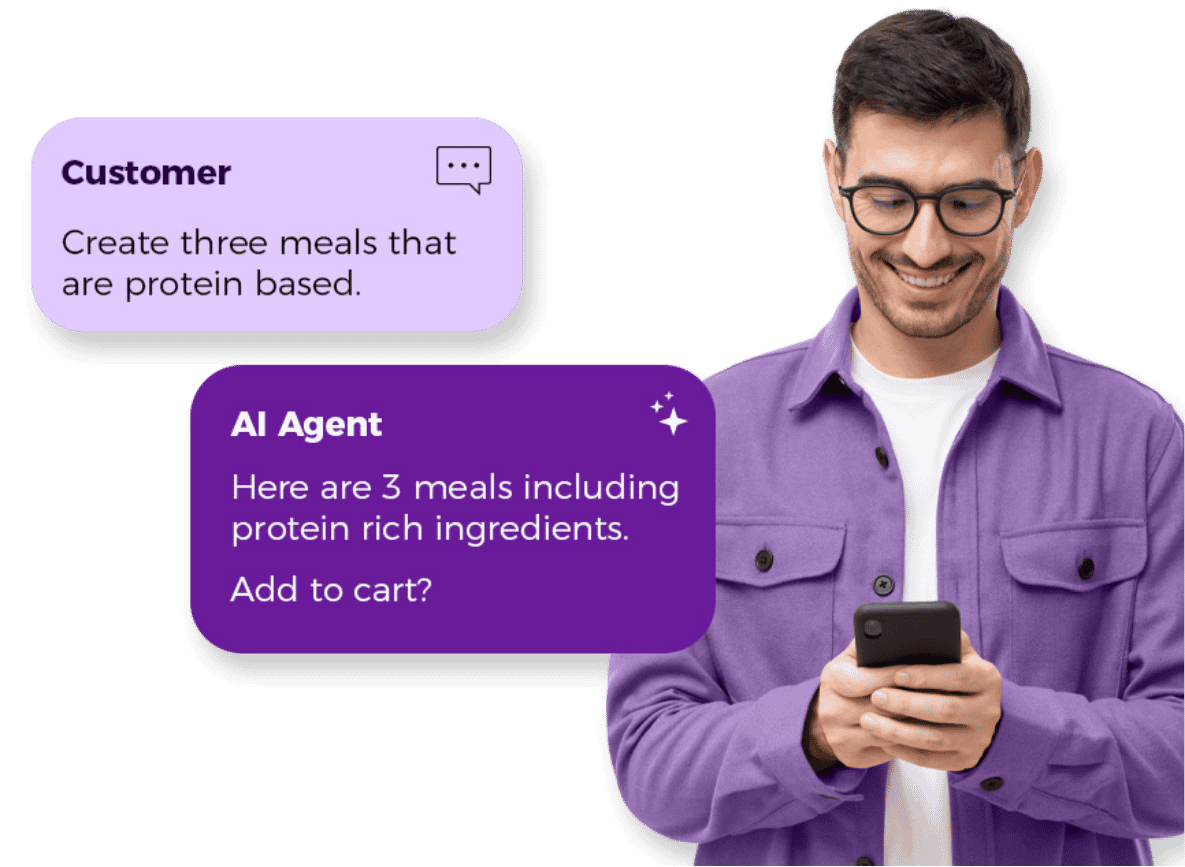
While Olive was previously limited to answering questions and directing shoppers to information as a chatbot, it has now become a proactive, personal digital concierge that helps users plan meals, interpret handwritten recipes, apply loyalty discounts, and place suggested items directly into online baskets.
Customers retain final approval over purchases, but Olive exemplifies the AI-powered shift in decision-making, wherein shoppers review and approve AI-curated selections rather than actively browsing and comparing products.
For retailers that have not yet invested in AI capabilities, the window is narrowing. Deloitte Digital's 2025 US Retail Industry Outlook found that 67% of retail executives are already using, or plan to use, AI for personalized product recommendations or search within the next 12 months. The evidence is mounting that visible, integrated AI interactions are not a future consideration but an immediate need.
The ability to deliver personalized experiences wherever the customer is, whether online or in-store, on messaging platforms or through a voice assistant, is why AI is central to the future of loyalty design, offer targeting, and customer engagement. Consistency across channels is becoming more attainable as the digitized store expands, and AI enables retailers to deliver a customized experience by personalizing searches and recommendations while understanding consumer context and intent.
Loblaw: Meeting Customers Where They Are
Loblaw, Canada’s largest grocer, moved quickly when OpenAI announced third-party app integrations, becoming one of the first retailers to embed its ecommerce platform directly into ChatGPT.
The PC Express integration lets shoppers plan meals, generate ingredient lists, and populate shopping carts within the ChatGPT interface and then complete checkout through Loblaw’s app.
While Loblaw is also developing conversational AI tools within its own PC Optimum and PC Express apps, its integration with ChatGPT reflects the retailer’s efforts to adapt to customer behavior and meet them on the platforms they already use.
AI platforms like Gemini or ChatGPT have a tremendous (sometimes uncanny) ability to understand their users. But retailers’ relationships with their customers can go much deeper if they supplement their data advantage with AI-powered personalization and accelerate their execution timelines. Otherwise, the recommendations from AI platforms may be sufficient to drive traffic elsewhere.
However, there is still some work to do on that front. Many retailers struggle to integrate personalization into relatively straightforward customer interactions. A recent study by Google Cloud and RGA, analyzing 56 major EMEA retailers across 41 million data points, found that only 9 out of 56 retailers provide highly personalized search results based on a customer’s profile.
The ability to personalize at scale remains retailers’ best bet for retaining customer relationships. But as the gap in personalized search results indicates, it is also their biggest operational and technical challenge. The intent is there, but the execution often lags.
The right AI tools can harness the data retailers already hold to deliver real-time individualized offers based on thousands of metrics.
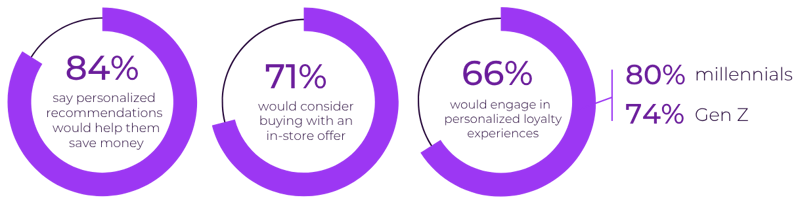
Eagle Eye's research documents the consumer appetite for personalized experiences: 84% believe personalized recommendations would help them save money at the shelf, and 71% would consider buying a product or find it helpful if they received an offer while shopping in-store. Perhaps most tellingly, 66% of consumers would participate in personalized games, contests, or challenges through a loyalty program, with even higher rates among younger demographics (80% of millennials and 74% of Gen Z).
AI can help retailers meet this demand. Generative AI can help promotional and loyalty initiatives move beyond previous “next best message” capabilities and pinpoint specific offers to individual customers at scale, significantly improving relevance and driving stronger engagement. Retailers using this data-driven approach to tactical personalized loyalty campaigns have realized an average of 3.8% like-for-like sales uplift, even in price-sensitive markets.
Retailer-owned customer data is the key to hyper-personalization, and in the age of agentic commerce, retailers will almost certainly have to expose some of it to AI platforms. Allowing AI platforms to connect to this data means the AI will learn from it, which poses some risk. The solution lies in sharing decision outputs, not intelligence, but this depends on both the technological quality of the connections between the retailer’s loyalty platform and AI platforms and the ability to make decisions in milliseconds. Retailers must be able to control the data exposed on AI platforms, including differential pricing per customer, the option to use reward balances, and the quality of results.
Consumers’ Apptetite for Personalization
If a retailer’s platform lags during loyalty member ID verification, for example, an agent may default to a competitor whose API is faster. If loyalty can’t respond in real time, it won’t show up in an agent-driven decision.
What's Loyalty Got to Do With It? Opportunities and Threats to Retail Loyalty Programs
The good news is that AI can make loyalty programs both discoverable in agentic commerce situations and "super personalized" in delivering tailored experiences and offers that resonate deeply with individual customers. The fact that the growth of AI adoption for retail commerce is consumer-driven amplifies this advantage; consumers are ready for a better, more tailored experience.
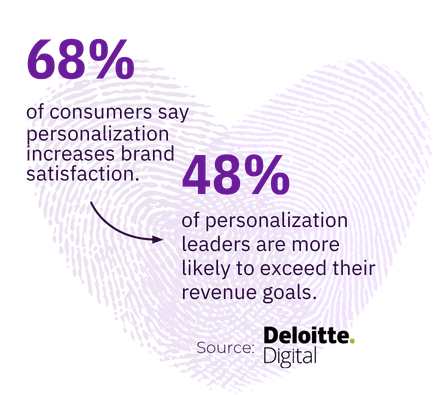
The data supports this readiness. Deloitte Digital research found that 68% of consumers say personalization significantly increases brand satisfaction, and, as a result, personalization leaders are 48% more likely to exceed their revenue goals. The question is no longer whether personalization works, but how to deliver it at the scale and speed that modern consumers demand.
More good news: loyalty is a growth engine, not simply a marketing lever. The data programs generate are incredibly valuable, and generative AI can help retailers pinpoint the most profitable ways to use loyalty, maximizing return on investment by optimizing offers and engagement strategies. Retailers using well-designed loyalty programs report 16% larger basket sizes, an overall lift in spend, reduced churn, and lower promotion costs.
Retailers must understand and embrace the loyalty program's role as a first-party (and zero-party) data source. As privacy regulations tighten and third-party data becomes less available, loyalty programs are among the most valuable sources of customer insight. The program that generates rich, consented data becomes a strategic asset for retailers, extending well beyond its traditional role as a marketing vehicle.
Loyalty programs are no longer just marketing tools, they’re powerful sources of first- and zero-party data. Programs that capture rich, consented insights become strategic assets for retailers.
Generative AI creates a level of sophistication that is simply impossible with manual processes. Consider the difference between a loyalty program that sends the same monthly email to every member and one that adjusts the timing, channel, content, and offer for each individual based on their specific patterns and preferences. The first approach is efficient but impersonal; the second creates a sense of relationship rather than a “spray and pray” strategy.
AI also helps retailers be generous with the right customers in the right way, and know when not to discount, thereby improving profitability and return on promotional spending. Retailers have been able to do this effectively through data mining, but with AI, they can react in real time.
Eagle Eye's platform, for example, executes more than 1.7 billion personalized offers weekly and manages over 750 million loyalty member wallets worldwide.
But just as AI is delivering significant benefits to retailers’ ability to personalize promotions at scale, the risks it creates for loyalty are also real.
Foremost among these is the prospect of commoditization and the inability to differentiate a retail brand in an AI-intermediated shopping journey. In an agentic commerce world, there is no inherent reason for a customer to choose one brand over another if AI presents the cheapest or quickest option.
Without strong loyalty, retailers risk becoming mere "catalogs" or "delivery slots" on AI platforms, fulfilling orders generated elsewhere rather than owning the customer relationship.
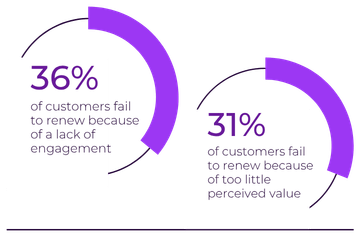
Eagle Eye’s research highlights the consequences of failing to engage loyalty members effectively: 36% of customers fail to renew their loyalty program memberships because of a lack of engagement, and 31% fail to renew because of too little perceived value. In an AI-intermediated world, these disengaged customers will be the first to drift toward agent-recommended alternatives.
Disengaged customers will be the first to drift toward agent-recommended alternatives
This is where the collaboration between strategy, technology, and execution becomes critical. Deloitte Digital brings the strategic expertise to assess organizational readiness, architect test-and-learn programs, and establish AI governance frameworks, ensuring retailers can confidently deploy AI capabilities amid increasing regulatory scrutiny. Their research found that the biggest barriers to GenAI deployment are regulation and risk management, lack of technical talent, and lack of a governance model; all areas where strategic guidance is essential.
Google Cloud provides the AI foundation: BigQuery for data warehousing, Vertex AI for machine learning, and generative AI solutions like Gemini for conversational experiences. This integrated platform means data flows from capture through analysis to activation without friction, reducing time from insight to action for real-time personalization.
Eagle Eye delivers the retail-specific execution layer, with a platform purpose-built for AI-driven personalization that can go live within weeks, not years.
ASDA, for example, launched its Rewards program in just 12 weeks after project kick-off:
- 6 million active members reached within 18 months
- 52% achieved double-digit incrementality in customer-level sales
- £525 million accumulated in Cashpots
This speed-to-value is repeatable for retailers who choose the right partners and approach.
Codependent, Symbiotic, or Healthy? What the Future Holds
Agentic commerce is in its very early stages, and considerable uncertainty remains about how the shopping experience will change for most consumers. What is clear is that AI presents both a radical opportunity for hyper-personalized loyalty and a direct threat to retailers’ customer relationships.
Retailers need to be prepared to shift their loyalty strategies from traditional marketing, retention, and frequency-driving activities to those that focus on the customer’s identity across any interface and deliver personalization when it matters most.
80%
of retail leaders at top-performing companies say their customer loyalty exceeds the industry average.
Retailers have cited personalization as their #1 priority in their customer strategy but have struggled to achieve it due to the scale of channels, decisioning, offers and content. AI and Agentic capabilities mean we are closer more than ever to achieving dynamic and contextual experiences.
The programs that succeed will be those that treat loyalty not as a marketing program but as a strategic infrastructure; one that captures rich first-party data, enables real-time personalization, and maintains relevance regardless of where or how the customer chooses to shop.
Deloitte Digital's research found that 8 in 10 retail executives from outperforming companies said their customer loyalty was well above the industry average, demonstrating the link between loyalty investment and business performance.
The relationship between AI and loyalty need not be complicated. In fact, the two are deeply complementary: AI needs the rich customer data that loyalty programs generate, and loyalty programs need AI to deliver the personalization that consumers expect. Retailers that recognize this symbiosis and invest accordingly will be well-positioned to thrive in the agentic commerce era.
How retailers approach their customer data and loyalty programs within this new AI-driven landscape will determine their relevance and profitability.
The technology exists, the expertise is available, and the consumer appetite for personalized experiences continues to grow. What remains is for retailers to take the plunge and act now.
If you’re ready to put AI at the top of your to-do list, working with the right partners can give you an advantage in preparing your organization for change.
Get in touch with the experts at Deloitte Digital, Google Cloud and Eagle Eye to get your AI strategy on the right track.